The Aligned Leader: Harnessing Conscious and Subconscious Minds for Peak Performance
In the complex and demanding landscape of modern leadership, the ability to make sound decisions, inspire teams, and navigate challenges effectively is paramount. While much attention is often given to conscious strategies, analytical thinking, and deliberate planning, a growing body of research highlights the profound impact of the subconscious mind on leadership effectiveness. Aligning the conscious and subconscious aspects of the mind is not merely a psychological concept; it is a critical pathway to unlocking enhanced performance, resilience, and visionary leadership.
Understanding the Dual Mind: Conscious vs. Subconscious
The human mind operates on two primary levels: the conscious and the subconscious. The conscious mind is responsible for our immediate awareness, logical reasoning, critical thinking, and intentional actions. It processes information actively, allowing us to set goals, analyze data, and communicate deliberately. In a leadership context, this is the mind that crafts strategic plans, evaluates risks, and makes executive decisions based on available facts.
Conversely, the subconscious mind is a vast reservoir of past experiences, beliefs, habits, emotions, and intuitions. It operates beneath the surface of our awareness, influencing our perceptions, reactions, and behaviors without direct conscious input. Neuroscientific studies suggest that the subconscious mind drives a significant portion of human behavior. Estimates indicate that as much as 95% of our daily actions and decisions are influenced by subconscious processes 1 2. This means that while a leader might consciously strive for a particular outcome, deeply ingrained subconscious patterns can either support or sabotage those efforts.
Here's a visual representation of this distribution:
The Disconnect: When Minds Collide
When the conscious and subconscious minds are misaligned, leaders often experience internal conflict, indecision, and suboptimal performance. For instance, a leader might consciously desire to foster an innovative and open culture, but if their subconscious holds beliefs rooted in fear of failure or a need for absolute control, their actions might inadvertently stifle creativity and risk-taking within their team. This internal friction can manifest as:
• Stress and Anxiety: The subconscious mind, wired for survival, can perceive high-pressure leadership situations as threats, triggering fight-or-flight responses that impair rational thought and decision-making 3.
• Negative Habits: Subconscious patterns can perpetuate counterproductive behaviors, such as procrastination, micromanagement, or avoidance of difficult conversations, even when the conscious mind recognizes their detrimental impact 3.
• Impaired Decision-Making: Decisions can be swayed by unconscious biases, emotional reactions, or past negative experiences, leading to choices that do not align with long-term strategic goals 4.
• Reduced Focus and Productivity: A subconscious mind constantly on alert for perceived threats can divert mental energy, making it difficult to maintain focus on critical tasks and diminishing overall productivity 3.
The Power of Alignment: Benefits for Leaders
Achieving alignment between the conscious and subconscious minds transforms leadership from a struggle against internal resistance to a powerful, integrated flow. When both aspects of the mind work in harmony, leaders can tap into their full potential, leading with greater clarity, authenticity, and impact. The benefits are extensive:
1. Enhanced Decision-Making and Intuition
Aligned leaders can integrate logical analysis (conscious) with intuitive insights (subconscious). The subconscious, with its vast processing capacity, can quickly identify patterns and connections that the conscious mind might miss, leading to more holistic and effective decisions. This synergy allows leaders to trust their gut feelings while still grounding them in rational thought.
2. Increased Resilience and Stress Management
By reprogramming subconscious responses to stress, leaders can develop greater emotional regulation and resilience. Instead of reacting impulsively to pressure, they can consciously choose their responses, viewing challenges as opportunities for growth rather than overwhelming threats. This leads to sustained well-being and prevents burnout 3.
3. Authentic Leadership and Stronger Relationships
When subconscious beliefs align with conscious values, leaders act with greater authenticity. This congruence builds trust and rapport with team members, fostering a more positive and collaborative organizational culture. Leaders become more self-aware, understanding their own biases and motivations, which enables more empathetic and effective communication 5.
4. Unleashed Creativity and Innovation
The subconscious mind is a wellspring of creativity. When leaders learn to access and integrate these subconscious insights, they can generate novel solutions to complex problems and inspire innovative thinking within their teams. This alignment removes mental blocks that often hinder creative expression 3.
5. Greater Focus and Productivity
With the subconscious mind working in concert with conscious goals, mental energy is optimized. Leaders experience fewer internal distractions and can maintain sustained focus, leading to higher productivity and more efficient execution of tasks. Repetitive tasks can be handled more effectively by the subconscious, freeing up conscious capacity for strategic thinking 3.
6. Accelerated Goal Achievement
When conscious intentions are supported by subconscious beliefs, the path to achieving goals becomes smoother. The subconscious mind, acting as a powerful internal guidance system, will naturally orient behaviors and perceptions towards desired outcomes, making success feel more inevitable and less effortful 3.
The Neurobiology of Alignment: Bridging the Prefrontal Cortex and Basal Ganglia
To truly understand the benefits of alignment, we must look at the brain's physical architecture. The conscious mind is primarily associated with the Prefrontal Cortex (PFC)—the seat of executive function, logical reasoning, and long-term planning. The subconscious mind, however, involves deeper structures such as the Basal Ganglia, which manages habits and automatic behaviors, and the Amygdala, which processes emotional responses and threats 7.
Misalignment often occurs when the PFC (the "CEO" of the brain) sets a goal, but the Basal Ganglia (the "Operations Manager") continues to run old, contradictory scripts. For example, a leader may consciously decide to delegate more (PFC), but their Basal Ganglia maintains a habit of micromanagement because it associates control with safety. Alignment training effectively "rewires" these neural pathways through neuroplasticity, ensuring that the brain's automatic systems support its executive goals rather than undermining them.
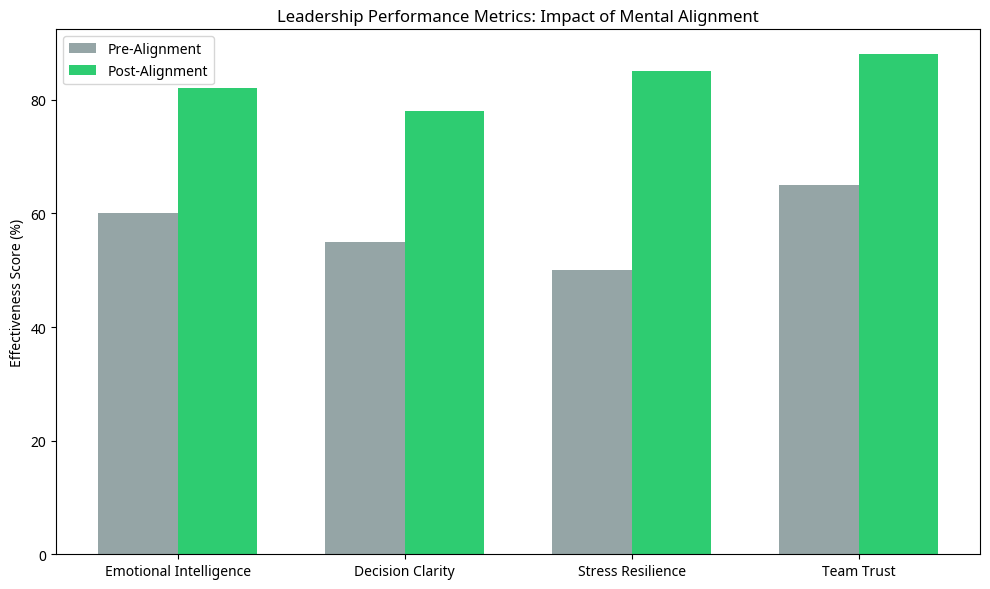
Research on the impact of alignment training, such as mindfulness practices, on leadership effectiveness shows significant improvements across various metrics:
Strategies for Achieving Conscious-Subconscious Alignment
Achieving this alignment is an ongoing process that involves self-awareness, intentional practice, and a willingness to explore one's inner landscape. Here are key strategies leaders can employ:
1 Mindfulness and Meditation: Regular mindfulness practices enhance self-awareness, allowing leaders to observe their thoughts and emotions without judgment. This creates a bridge between conscious awareness and subconscious patterns, enabling conscious intervention and reprogramming 6.
2 Visualization: By vividly imagining desired outcomes and embodying the feelings associated with success, leaders can program their subconscious mind to work towards these goals. This technique helps align subconscious beliefs with conscious aspirations 3.
3 Affirmations: Positive affirmations, when consistently repeated and genuinely felt, can gradually replace limiting subconscious beliefs with empowering ones. This rewires neural pathways to support conscious objectives.
4 Journaling and Self-Reflection: Regularly reflecting on experiences, decisions, and emotional responses can uncover subconscious patterns and biases. Journaling provides a space for conscious processing of subconscious influences, leading to greater clarity and insight.
5 Coaching and Mentorship: Working with a coach can provide an external perspective to identify blind spots and subconscious blocks. A coach can guide leaders through exercises and techniques designed to foster alignment and personal growth.
6 Emotional Intelligence Development: Cultivating emotional intelligence involves understanding and managing one's own emotions, as well as recognizing and influencing the emotions of others. This conscious effort directly impacts how subconscious emotional responses are processed and expressed.
Case Studies: Alignment in Practice
The benefits of mental alignment are not just theoretical; they are evidenced by some of the world's most successful leaders.
• Ray Dalio (Bridgewater Associates): Dalio has long attributed his success to transcendental meditation, a practice he uses to bridge the gap between his conscious analytical mind and his subconscious insights. By quieting the conscious "noise," he allows subconscious patterns to surface, which he then codifies into his famous "Principles." This alignment has enabled him to navigate extreme market volatility with a level of clarity and detachment that few can match 8.
• Satya Nadella (Microsoft): Nadella's leadership transformation at Microsoft was rooted in a shift from a "know-it-all" to a "learn-it-all" mindset. This required a deep subconscious reprogramming of the company's culture, as well as his own leadership style. By aligning his conscious vision of empathy and growth with subconscious behaviors that foster curiosity, he successfully revitalized one of the world's largest tech giants.
• Arianna Huffington (Thrive Global): After a collapse from exhaustion, Huffington realized her subconscious definition of "success" was misaligned with her physical and mental well-being. She now advocates for "thriving" through practices that align the mind's goals with the body's needs, demonstrating that sustainable leadership requires an integrated approach to mental health.
The Aligned Leader in Action
Imagine a leader facing a significant organizational crisis. A misaligned leader might react with panic, blame, or rigid adherence to outdated strategies, driven by subconscious fears. An aligned leader, however, would approach the situation with calm clarity. Their conscious mind would analyze the facts, while their subconscious, free from limiting beliefs, would offer creative solutions and maintain a steady emotional state. This leader would inspire confidence, make adaptive decisions, and guide their team through adversity with greater ease and effectiveness.
Here is a conceptual image of a leader with conscious and subconscious alignment:

Conclusion
The journey to becoming an aligned leader is a profound investment in personal and professional growth. By consciously engaging with and strategically influencing the powerful forces of the subconscious mind, leaders can transcend limitations, enhance their capabilities, and cultivate a leadership style that is both authentic and highly effective. In an era demanding adaptive, resilient, and visionary leadership, the integration of conscious and subconscious intelligence is not just beneficial—it is essential for navigating complexity and driving sustainable success.
References
[1] Neuroba. (2025, January 13 ). Understanding the Subconscious Mind and Its Impact on Behavior. Retrieved from
[2] Brainz Magazine. (2022, May 8 ). The Subconscious Mind's Role In Influencing Your Behavior. Retrieved from
[3] Arootah. (2025, March 8 ). Why the Subconscious Mind is Every Leader’s Secret Weapon. Retrieved from
[4] Ahead App. (2025, December 11 ). Conscious Mind and Subconscious Mind: Unite Them for Better Decisions. Retrieved from
[5] Harvard Business Review. (2025, May 8 ). Building Self-Awareness to Be A Better Human-Centered Leader. Retrieved from
[6] Tan, N., Peters, E. K., & Reb, J. (2023 ). Effects of a mindfulness-based leadership training on leadership behaviors and effectiveness. Mindfulness, 14(1), 1-15.
[7] National Institutes of Health. (2010 ). Prefrontal Cortex and Impulsive Decision Making. Retrieved from
[8] Ray Dalio. (2017). Principles: Life and Work. Simon & Schuster.